 Kamino finance
 connects lending and Multiply controls to the position or order state they change
Kamino finance presents actions such as supply, borrow, repay, withdraw, and adjust leverage alongside estimates of how they change a position. Start by identifying the relevant market and position type. Enter only the amount or leverage setting you intend, then compare the previewed collateral, debt, loan-to-value ratio, and wallet balance with the starting record. A wallet approval shows that you authorized a transaction; it doesn't prove the position changed. Completion requires a successful Solana transaction and a refreshed product record showing the intended balances, ratio, or order state. If either check fails, preserve the starting state, identify the failed condition, and decide whether a retry still fits the live parameters.
Updated on
Key takeaway: Review the live control preview, then accept the action only when the refreshed position or order record shows the intended balance, leverage, or fill status.
Market, rate model, and position type set the available controls
Three choices come before the amount: the market, the rate model, and the kind of position you intend to change. A variable-rate supply balance, a collateralized borrowing position, a fixed-rate order or position, and a Multiply position don't expose identical actions. Fixed-rate borrowing can use a direct borrow or a standing Borrow Order, and an order can remain partly or wholly unfilled until matching liquidity is available. The selected asset also matters because a reserve may permit supply, collateral use, borrowing, or only a subset of those functions. Read the active market and position label before treating any displayed maximum as available to the position you meant to edit.
Collateral deposited in one Kamino lending market can't support a loan in another market. Moving between market views therefore changes which balances, caps, borrow factors, and health limits govern the preview. Multiply also uses a different obligation type from a standard borrow. Selecting the wrong record can produce a valid preview for a position other than the one you planned to modify.
Current balances determine the next valid action
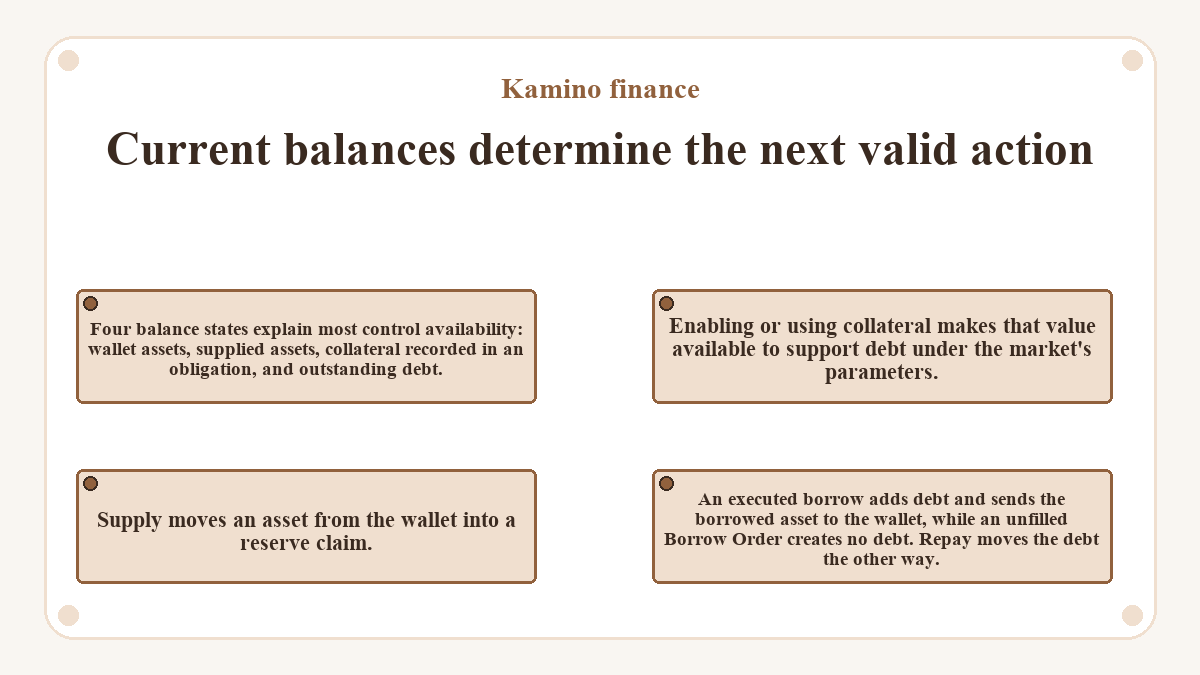
Four balance states explain most control availability: wallet assets, supplied assets, collateral recorded in an obligation, and outstanding debt. Supply moves an asset from the wallet into a reserve claim. Enabling or using collateral makes that value available to support debt under the market's parameters. An executed borrow adds debt and sends the borrowed asset to the wallet, while an unfilled Borrow Order creates no debt. Repay moves the debt the other way.
Withdrawals need a separate reading. An on-demand variable-rate supply withdrawal depends on reserve liquidity. Capital committed to a fixed-rate term can instead remain locked until liquidity returns and a withdrawal ticket advances. A collateral withdrawal also has to leave the borrowing position healthy. If debt is present, the previewed post-action LTV provides more useful evidence than the withdrawal amount alone. A disabled control can therefore reflect a state constraint rather than a wallet connection problem.
Amount and leverage controls change different relationships
One amount changes one side of a standard lending position. Supplying or withdrawing alters supplied value, while borrowing or repaying alters debt. Each preview should identify the affected asset and show whether its balance rises or falls. A larger collateral balance can add capacity; a larger debt balance consumes it. The exact capacity still comes from the selected market's live risk settings.
Multiply separates size from leverage. Adjust Size is meant to add or remove position value while keeping the leverage ratio unchanged. Adjust Leverage changes both collateral and debt, which moves current LTV. These controls can show similar currency values but change the position differently, so compare collateral, debt, and leverage together.
A swap-dependent adjustment also introduces a slippage tolerance. That setting governs the least favorable swap execution the transaction may accept; it isn't extra leverage or a return target. A wider tolerance makes a worse execution acceptable, while a tighter tolerance can increase the chance of reversion when the quote moves. Use the previewed minimum output where it appears.
How can you tell whether the transaction completed?
Two records answer that question: the Solana transaction status and the refreshed Kamino position or order. The wallet prompt records authorization, and a submitted signature identifies the attempted transaction. Neither alone proves that the requested program instructions succeeded. Check for a successful status, then confirm that the refreshed position or order record shows the expected result. For a Borrow Order, check the filled amount and any open remainder separately because creating the order doesn't mean the loan was funded.
For a supply or collateral deposit, the relevant position balance should rise. A borrow should add debt; a repayment should reduce it. A withdrawal should lower the recorded supply or collateral and return value to the wallet. Multiply adjustments should move leverage, collateral, and debt in the combination shown by the reviewed preview.
A failed transaction leaves the requested position change unapplied, although Solana can still charge its transaction fee. If the chain reports success but the interface still shows the old state, refresh the account-backed view before submitting again. A duplicate retry made during a display delay can create a second valid action rather than repair the first.
Five checks before treating the action as complete
Use these five checks to compare the starting record with the final position or order without relying on an expected return. They apply only to the active position or order and its current configuration.
- Starting record: note the selected market, rate model, position or order type, wallet balance, collateral, debt, current LTV, and leverage when applicable.
- Chosen action: record the exact operation, asset role, entered amount, and any rate, term, leverage, or slippage setting that you reviewed.
- Projected state: confirm the expected collateral, debt, LTV, wallet movement, swap output, and Borrow Order fill status where each applies.
- Submitted transaction: match the wallet request to the reviewed transaction, approve it, and retain the resulting signature for the status check.
- Confirmed state: accept completion only after success is reported and the refreshed position or order matches the intended result; otherwise inspect the failure before retrying.
The available action may change after any confirmed transaction, price update, utilization change, or risk-parameter update. Build a fresh preview from the new state instead of treating an earlier maximum or quote as reusable. This keeps the next decision tied to the position that actually exists.
LTV separates borrowing capacity from liquidation distance
Three LTV readings serve different decisions. Current LTV is debt value divided by collateral value. Max LTV limits new or increased borrowing, while liquidation LTV marks the boundary for liquidation eligibility. A position may remain below its liquidation threshold yet have little or no room for another borrow.
A lending position becomes eligible for LTV-based liquidation when current LTV reaches its applicable liquidation LTV. The distance between current LTV and that threshold is the relevant buffer after a borrow. A borrow factor can increase risk-adjusted debt and reduce capacity for the same market value. It belongs in the control review whenever the chosen debt asset carries one. After an applicable post-maturity grace period, an unpaid fixed-rate loan can become eligible for liquidation regardless of its collateral LTV.
An elevation mode can change the permitted LTV only for designated asset combinations. Its higher capacity also leaves less room between an aggressive operating ratio and the liquidation boundary. Treat the active mode as a position property, not a universal setting.
Both sides can move without a new wallet action. Accrued interest increases debt, while market prices alter collateral and debt values. A preview is therefore a time-specific estimate. After confirmation, the refreshed current LTV and underlying balances establish the record for monitoring or for the next control.
Repayment and withdrawal create different exit states
Repayment changes debt; withdrawal changes the asset left in the protocol. Repaying with wallet funds should reduce the chosen debt while leaving collateral in place. Early repayment of a fixed-rate loan during its first term also carries a penalty, so include that previewed cost when comparing exit states. A collateral withdrawal can proceed only if the remaining position satisfies its health constraints. For a supply-only position, available reserve liquidity determines whether the underlying asset can be redeemed immediately.
Multiply also supports debt reduction using collateral. That operation sells part of the collateral to repay debt and leaves the remaining value in the position. A deleverage-and-withdraw action instead repays debt from sold collateral and returns the remainder to the wallet. The preview should make the destination visible through the projected position and wallet balances.
A full exit needs separate evidence for each obligation. Confirm that debt has cleared, collateral is no longer locked in the position, the intended asset reached the wallet, and any open Borrow Order has been resolved. If any balance or open order remains, the exit isn't complete even when one part of the action succeeded. The next decision is whether to withdraw, repay, cancel an order, or leave the remaining position open.
Multiply commits one combined state transition
One Multiply adjustment coordinates several operations that manual looping would separate. The selected leverage and input amount determine the needed collateral and debt relationship. A swap route and minimum output then constrain execution. Reviewing only the final multiplier misses the debt, swap, and LTV changes required to produce it.
Opening a Multiply position combines the flash loan, swap, collateral deposit, borrow, and flash-loan repayment in one atomic transaction. Because the sequence is atomic, a failure in any required step leaves the requested adjustment unapplied. This all-or-nothing behavior makes the starting position the comparison baseline after a failure. It doesn't make the requested leverage safe once the transaction succeeds.
After success, confirm total collateral, total debt, leverage, current LTV, and wallet movement. Net APY is a performance estimate, not completion evidence. It can help evaluate the position after creation, but completion is established by the recorded balances and risk metrics. If the position differs from the preview's intended direction, stop before making another adjustment.
Live parameters reshape the next preview
Rates, prices, liquidity, caps, and risk settings can change the action available from the same wallet balance. Variable lending rates respond to reserve utilization. Supply APY reflects borrower interest and utilization, while incentives may be displayed separately. A number shown during one review shouldn't be treated as a fixed term for a later transaction.
Position health can also drift after confirmation. Debt accrues interest, asset values move, and a Multiply yield spread can narrow or turn negative as the borrow rate changes. None of those updates means the earlier transaction failed.
Return to the active position before adding debt, removing collateral, changing leverage, or attempting an exit. Compare the fresh preview with the last confirmed record. Then accept only the state change that matches the current task and current configuration.
What readers ask about Kamino finance
Why might a borrow control stay unavailable when collateral appears?
The control may be unavailable because collateral and borrowing capacity are market-specific. A wallet balance or supplied asset may not be active collateral in the selected market, and current LTV, borrow factors, reserve liquidity, or caps may leave no additional capacity. Reopen the intended position, check the asset's role and projected LTV, and use only the amount that the fresh preview accepts.
Can two actions be compared from the same position snapshot?
Yes, as long as you haven't submitted either action and the position, quote, and market parameters remain unchanged. Compare the same fields: wallet movement, collateral, debt, current LTV, leverage, and minimum swap output where relevant. After one transaction confirms, discard the other preview and rebuild it from the new position because the earlier comparison no longer shares a starting state.
Does the displayed supply APY include every available reward?
No. In a variable-rate reserve, the base supply APY represents interest paid by borrowers and passed to suppliers; incentives and farm rewards are shown separately when available. A fixed-rate position follows its stated rate and term instead of the utilization-based supply APY. Add each component only if the interface explicitly lists it for the selected reserve, and don't treat a temporary incentive as part of the underlying borrow-interest rate. The confirmed supply balance proves deposit completion, while the displayed return must be read according to the selected rate model and term.
What happens if the swap quote moves before a Multiply transaction lands?
The transaction should revert if execution can't satisfy the minimum output set by its slippage tolerance. Atomic reversion prevents a partial Multiply position from being committed, but it doesn't prevent Solana from charging the transaction fee. A changed route, expired quote, or insufficient liquidity can require a fresh preview before another attempt. Don't widen tolerance without reviewing the new worst-case output.
Is the displayed maximum guaranteed to execute?
No. A displayed maximum is calculated from the position and market state used for that preview. Prices, reserve liquidity, caps, borrow factors, or another confirmed action can change the executable amount before signing. Build a fresh preview, check the projected post-action state, and treat a reversion as a failed attempt rather than evidence that the position reached the earlier maximum.
Which values matter after a successful repayment?
Use the outstanding debt balance as the primary completion check. The refreshed collateral amount, current LTV, wallet balance, and transaction status provide supporting evidence. Debt should fall in the intended direction, while current LTV normally improves if collateral value and other inputs remain stable. A wallet debit alone only shows that funds moved; it doesn't prove the obligation updated.
Why can Net APY change after a Multiply adjustment?
Net APY is recalculated from inputs that can move, including collateral yield, borrow cost, and leverage. Variable borrow rates respond to reserve utilization, so the spread can change without another wallet action. Treat the refreshed Net APY as an estimate for the confirmed position, then separate that performance estimate from the recorded collateral, debt, and LTV that prove completion.
Could a supply withdrawal wait even when there's no debt?
Yes. In a variable-rate reserve, a supply-only position can have no debt and still face a liquidity constraint if much of the reserve has been borrowed. Its claim remains represented by kTokens until enough underlying liquidity is available for redemption. Capital committed to a fixed-rate term follows its maturity and withdrawal-queue rules instead of the same on-demand path. Check the current reserve or ticket state rather than assuming that a previously previewed amount remains immediately redeemable in full.